
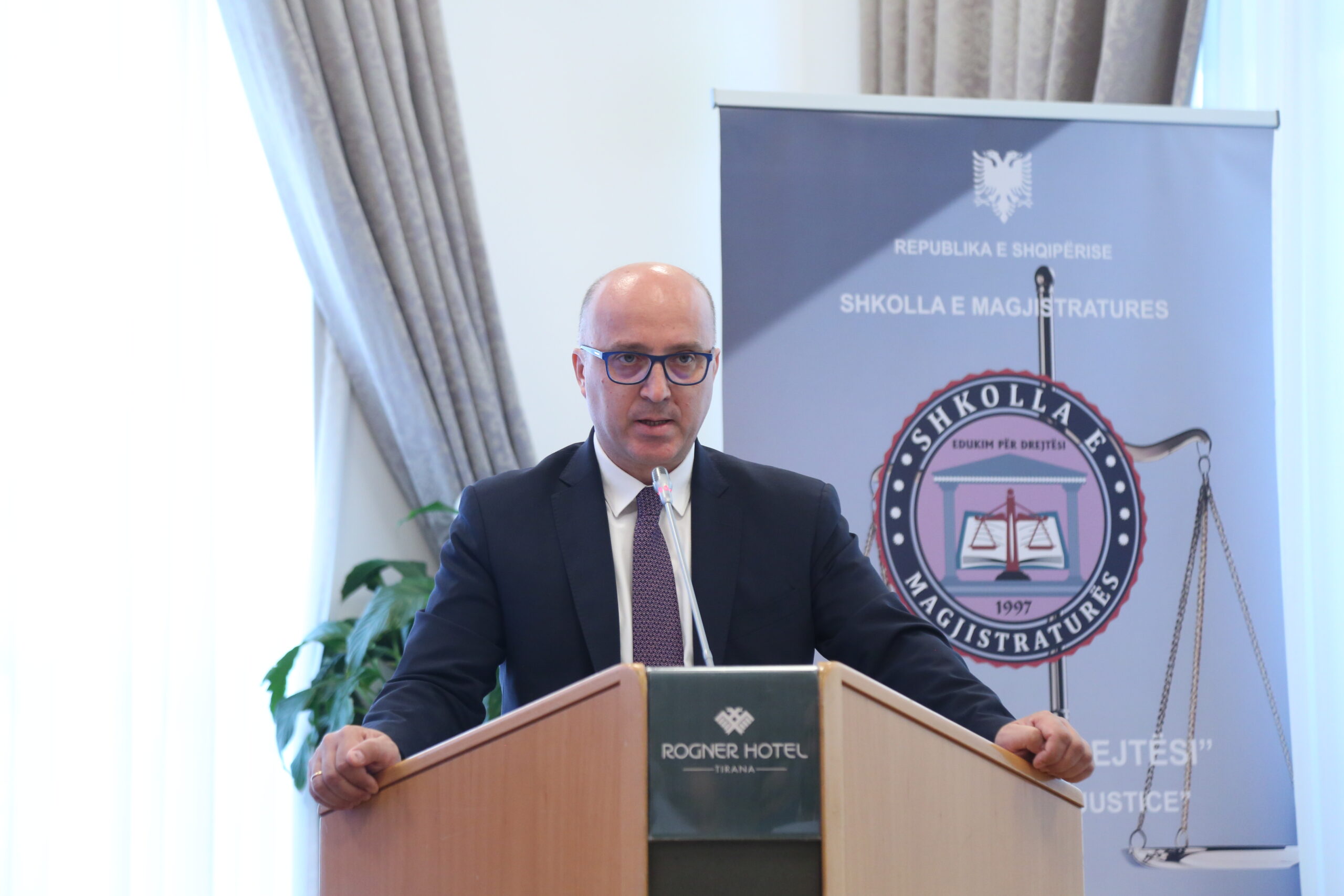
The High Inspector of Justice, Mr. Artur Metani, participated in the national conference “The dimension of integrity in the function of the magistrate. Commitment to justice”, organized by the School of Magistrates, with contributors from leading justice institutions, magistrates, lawyers, educators and representatives of civil society.
Mr. Metani spoke on the topic “The Rule of Law put up to the test: Independence or Accountability?” analyzing the dynamic and delicate relationship that exists between the independence of the judiciary and the legitimate need for public accountability, a subject of debate today among legal professionals, also in Europe and beyond.
The formal legal independence of magistrates requires institutional guarantees, but must be accompanied by a high standard of integrity and professionalism of the magistrates themselves, said the High Inspector of Justice in his speech.
“In Albanian practice, this principle has often been put to the test. Magistrates have often been exposed to direct or indirect interference, which has manifested itself through personal intimidation, media pressure, polarized political discourses, the use of political rhetoric to influence judicial perception and decision-making, conflict of interest, or centralized administrative decision-making, not always based on clear legal criteria or procedures. Addressing this issue requires building an institutional culture of protecting the independence of magistrates, establishing independent oversight and accountability mechanisms, as well as establishing clear standards on political deontology, in relation to its relationship with the judiciary…. The most important consequence of the principle of independence of magistrates is the lack of responsibility for the decisions they make, according to their judgement based on the law. In judging a case, they make decisions based on the law and according to their internal thought. Functional and personal independence does not imply immunity or lack of checking. Therefore, the consequence of power and the trust that society gives to magistrates is such that there must be some way to hold them accountable. Any attempt to protect the independence of the judiciary is not legitimate if it is not accompanied by a reaction on the form, essence and limits of the exercise of the accountability system of magistrates, since without clear rules for the checking of judicial power, we risk turning magistrates into silent sovereigns. Therefore, the increase in the competence and independence of magistrates must be accompanied by an effective accountability system.
The Office High Inspector of Justice, said Mr. Metani, represents the fundamental mechanism that connects the independence of the magistrate with the accountability system and their public responsibility.
“The greatest challenge today of the High Inspector of Justice is to maintain its institutional independence, as well as to be an important contributor to guaranteeing the independence of the judiciary, in an environment where direct or indirect influence or interference with the judiciary are not unknown. In order not to become a means of pressure on magistrates and the judiciary, the HIJ is trying to implement the highest standards of due process, to ensure transparency in the procedures carried out by the institution and to demonstrate integrity in every decision-making. The HIJ is trying to conceive and apply this accountability mechanism in an institutional, fair and sustainable manner, as the highest form of public accountability of magistrates. The role of the HIJ should not be seen simply in the disciplinary punitive dimension, but in a broader educational and preventive aspect, in order to create a high ethical and professional culture in the judiciary. In this way, this institution is committed to becoming a true supporter of the principles of the rule of law, while maintaining the sensitive balance between accountability and independence of the judiciary. “
Seeing independence and accountability as an organic duality, which helps consolidate the rule of law, Mr. Metani noted that we must reflect on building a justice system that guarantees both, while administration of justice should be a public service.
“Today more than ever, justice in Albania needs magistrates and professionals with high moral integrity, aware of their constitutional role and committed to justice, as a public service, while preserving its pure interests. There is a need for magistrates who truly believe, not only in social values, but also in their personal mission to serve the justice system. This is naturally linked to the further strengthening of accountability and responsibility. All of us, as members of the justice system, have the duty to prove through our work, institutional behavior and professional culture that independence is not a personal privilege of magistrates, but a tool at the service of the citizens and that accountability is not a limitation or violation of the independence of the judicial power, but a mechanism to exercise this independence responsibly. At the same time, I believe that it is equally important to respect the functioning of the constitutional mechanism of this important balance, as a tool, perhaps the only one, for the revival of the judicial system.”
Full speech of the High Inspector of Justice Mr. Artur Metani as follows
Hello everyone!
First of all, let me congratulate the organizers of this conference, Mr. Rakipi and the School of Magistrates, for bringing to the debate one of the most fundamental issues of the constitutional debate and the democratic order today, not only in Albania, but also in Europe and beyond, such as the dynamic and delicate relationship that exists between the independence of the judiciary and the legitimate need for public accountability. An issue that has become the real test of the rule of law, as part of the challenges that justice is going through everywhere. Therefore, I would like to use this opportunity to share with you some of my reflections on the very important and fundamental issues that are currently related to the engagement of magistrates and their essential role in the justice system.
The independence of the judiciary constitutes in itself a cornerstone of a democratic state and is inseparable from the very meaning of the functioning of the rule of law. But just as important as this principle, it should be noted that in our societies today, as the former French High Inspector describes it, a strange paradox is being observed: “Never has the demand for justice been so strong and never have justice systems been in such a fragile state”. Perhaps for this reason, or in its name, some societies are facing an aggressive “influence” of the executive (or legislative) power on the judicial power and in the meantime, the search for and application of the necessary mechanisms to protect the independence of the judicial system still remains a challenge, even in countries with advanced democracies.
This reality makes it even more necessary to consolidate an institutional architecture that guarantees magistrates not only formal legal independence, but also moral and social support to exercise their function in an independent, impartial, courageous and fair manner. This is a natural process of transformation and continuous development. Of course, each institutional model is different and must be understood in light of the stage of development of a given country.
The independence of the judiciary contains two dimensions, the institutional aspect and the ethical-personal one. Thus, the independence of the judiciary requires clear guarantees in the institutional aspect, but on the other hand this independence must be accompanied by a high standard of integrity and professionalism of the magistrates themselves.
In Albanian practice, this principle has often been put to the test. Magistrates have often been exposed to direct or indirect interference, which has manifested itself through personal intimidation, media pressure, polarized political discourses, the use of political rhetoric to influence judicial perception and decision-making, conflicts of interest, or centralized administrative decision-making, not always based on clear legal criteria or procedures. Addressing this issue requires building an institutional culture of protecting the independence of magistrates, establishing independent oversight and accountability mechanisms, and establishing clear standards on political deontology, in its relation with the judiciary. At the same time, the lack of independence has also resulted from biased behavior on the part of magistrates themselves, as a result of lack of professional training, behavior committed with direct malice, or as a result of their lack of ethics and integrity. For this purpose, it is necessary for our legal system to have an active and dynamic response to the challenges that arise, as well as a systematic adaptation to the ongoing needs to guarantee this independence and accountability. This process should begin with increased attention, from the early stages of the education of magistrates at the School of Magistrates and continuing throughout their professional career.
The most important consequence of the principle of independence of magistrates is the lack of responsibility for the decisions they issue, according to their judgement based on the law. In judging a case, they make decisions based on the law and according to their inner thought. Nevertheless, functional and personal independence does not imply immunity or lack of check. Therefore, the consequence of the power and trust that society gives to magistrates is such that there must be some way to hold them accountable. Any attempt to protect the independence of the judiciary is not legitimate if it is not accompanied by a reaction on the form, essence and limits of the exercise of the accountability system of magistrates, since without clear rules for the checking of judicial power, we risk turning magistrates into silent sovereigns. Therefore, increasing the competence and independence of magistrates must be accompanied by an effective accountability system.
The accountability of the judiciary should not be seen as a limitation to its independence, but as a prerequisite for guaranteeing institutional legitimacy and strengthening public trust in justice. It should not be conceived as a limitation of independence, but as a mechanism that strengthens it. Respect for justice does not lie only in its decisions, but also in the way judicial decisions are made. Therefore, the form in which justice is administered is as important as its content.
In this sense, accountability represents not only the highest level of commitment to citizens and respect for the fundamental mission of justice, but also represents the ability of the judiciary to reflect on its activity, to justify institutional behavior, to improve the quality of justice and to act in accordance with the highest standards of ethics and professionalism.
In Albania, the justice reform brought a radical institutional transformation aiming to restore public trust in justice through the establishment of new institutions and the strengthening of professional standards. Among these institutions, a key role is played by the High Inspector of Justice (HIJ), which represents the fundamental mechanism that links the independence of the magistrate with the accountability system and their public responsibility.
The greatest challenge today of the High Inspector of Justice is to maintain its institutional independence, as well as to be an important contributor in guaranteeing the independence of the judiciary, in an environment where direct or indirect influence or interference with the judiciary is not unknown. In order not to become a tool of pressure on magistrates and the judiciary, the HIJ is trying to implement the highest standards of due process, to ensure transparency in the procedures developed by it, and to demonstrate integrity in every decision-making.
The HIJ is trying to conceive and apply this accountability mechanism in an institutional, fair and sustainable manner, as the highest form of public accountability of magistrates. The role of the HIJ should not be seen simply in the disciplinary punitive dimension, but in a broader educational and preventive aspect, in order to create a high ethical and professional culture in the judiciary. In this way, this institution is committed to becoming a true supporter of the principles of the rule of law, while maintaining the sensitive balance between accountability and independence of the judiciary.
This is not just rhetoric, but an important principle in which HIJ truly believes. It is also a difficult challenge, which can only be faced through a measured and careful approach, not succumbing to the heated debates of the moment, but taking into account the long-term effects and a single goal, which is the establishment and functioning in the future of the judiciary on strong foundations of independence and accountability. This not only requires time, but also sustainability. I truly believe that we are on the right track.
Following this reflection on the balance between the independence and accountability of magistrates, I feel obliged to emphasize that these two principles are not in conflict with each other, but in a healthy symbiosis, which guarantees the functioning of the rule of law. The classic dilemma between independence and accountability is essentially a challenge to build a functional symmetry between them, a balance that is not only a legal requirement, but an important prerequisite for maintaining the legitimacy of the judiciary.
Finding a sustainable balance between these two values is an ongoing challenge. Absolute independence, in the absence of effective accountability mechanisms, risks leading to a lack of efficiency, a lack of transparency and a violation of the principles of institutional and public accountability of magistrates. At the same time, the establishment of an accountability mechanism for magistrates, not based on legal criteria or standards and not within the framework of the carrying out of procedures according to due process, may pose a serious risk to the independence of the judiciary and expose it to inappropriate influences, including interferences of a political nature.
At first glance, this relationship may appear as an inevitable conflict between the right to judicial independence and institutional checking over the exercise of judicial functions. In a consolidated constitutional order, judicial independence and accountability are constructed as two complementary dimensions of the same institutional architecture, representing an organic and irreplaceable duality that helps consolidate the rule of law.
So, in this context, the question that arises is not “Independence or accountability?”, but “How do we build a justice system that guarantees both?”, since the relationship between them is not only theoretical, but also practical and existential for the very functioning of the rule of law. A constitutional order that aims to guarantee equality in front of the law, protection of fundamental human rights and the proper functioning of democratic institutions cannot be imagined without an independent judiciary that is simultaneously accountable to society. Only through the right balance between these two fundamental principles can a justice system be built that is both independent in decision-making and functions efficiently and with integrity.
Dear colleagues!
Today, Albania is at an important moment, where the challenge to consolidate new justice institutions cannot be won without a deep institutional and social awareness of the role of justice in the rule of law.
The rule of law does not represent only an aspect of legal rules and norms, but also a social order where the law prevails, where the functional separation of powers is not only a theoretical principle, but a real and “living” checking mechanism, where fundamental human rights have an inalienable status and are protected through effective legal tools.
The challenge regarding the rule of law is not only legal within the framework of a legislative process, but also historical, institutional, cultural or social. It requires a joint effort of all powers to cultivate a system where everyone is equal in front of the law and where the citizens have real faith in the protective function of justice. Meanwhile, it is worth noting that the courts, in this paradigm, are not only interpreters of the law, but also guarantors of the constitutional order and defenders of the principle of the rule of law.
The judicial reform, adopted in 2016, represents a major structural undertaking in the legal and institutional life of our country, aiming to restore public trust in the judiciary. It was conceived as a comprehensive intervention to address the systemic problems of corruption, inefficiency and political influence regarding the functioning of the justice system for a long period of transition. Nevertheless, the judicial reform cannot remain an initiative limited in legal acts or formal institutional structures. It must find embodiment in the functioning of the judicial bodies, as well as in the ethical behavior of magistrates, in the independence of their decision-making and in the rejection and punishment of any attempt to instrumentalize it.
The reform of the judiciary has been a major step, but not enough. In order for effects to be tangible, it must be accompanied by a deep professional reflection and commitment to building institutions that have the trust of Albanian citizens. This requires not only legal reforms, but also a transformation of institutional culture, a new awareness of justice and a permanent commitment to honesty and professionalism. Therefore, reform cannot be only the totality of legal changes or the establishment of new institutions. It must be accompanied by a cultural transformation, which requires institutional cohesion, political stability and the maturity of our society.
Let us be aware that the failure to protect this important balance between the independence and accountability of magistrates does not only constitute a deviation from the implementation of the spirit of the principles and standards of democracy and the rule of law, but a crisis of confidence, which undermines the essence of the constitutional legitimacy of the organization and functioning of our society.
For this reason, my call today is for a joint commitment of all of us, as legal professionals, as magistrates, heads of the institutions of governance of the justice system, academics, civil society organizations, to cultivate a professional culture based on dignity, self-restraint and civic courage, in order to contribute as much as possible to maintaining this balance in the function of democracy and the rule of law, with the aim of serving its citizens and future generations.
Today more than ever, justice in Albania needs magistrates and professionals with high moral integrity, aware of their constitutional role and committed to justice, as a public service, while keeping its interests pure. There is a need for magistrates who truly believe, not only in social values, but also in their personal mission to serve the justice system. This is naturally linked to the further strengthening of accountability and responsibility. All of us, as members of the justice system, have the duty, through our work, institutional behavior and professional culture, to prove that independence is not a personal privilege of magistrates, but a tool at the service of the citizens and that accountability is not a limitation or violation of the independence of the judicial power, but a mechanism to exercise this independence responsibly.
At the same time, I believe that it is equally important to respect the functioning of the constitutional mechanism of this important balance, as a tool, perhaps the only one, for the revival of the judicial system.
Thank you !