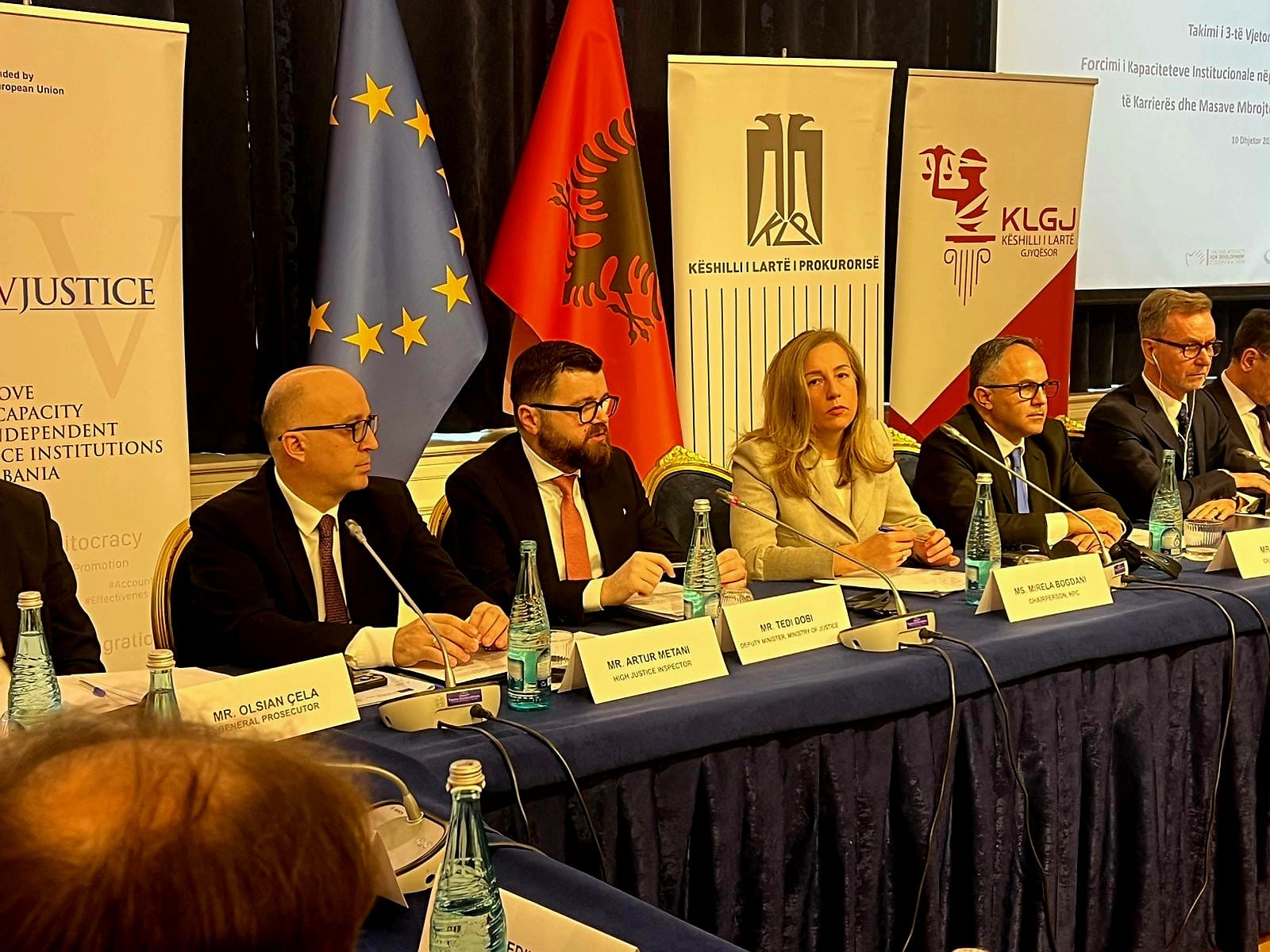

The High Inspector of Justice, Mr. Artur Metani, participated in the 3rd Joint Meeting of the High Judicial Council and the High Prosecutorial Council “Strengthening Institutional Capacities through Improved Career Development and Protective Measures for the Judicial System”.
In his speech, Mr. Metani first emphasized the practices that must be followed to have a strong and sustainable justice system.
“Building a strong and sustainable justice system requires continuous commitment. The rule of law is not simply a set of legal norms or abstract rules, but is above all an institutional administrative activity. In this context, the administrative practices followed by our institutions should aim to build an environment where meritocracy, structural independence, institutional security and the professionalism of magistrates act as interdependent mechanisms.”
The High Inspector of Justice also focused on the findings observed during the work of the institution he leads that affect the quality of work and the performance of magistrates and as such must be addressed.
“During the review of complaints or during the conduct of thematic/institutional inspections by the institution of the High Inspector of Justice, it has been found that the lack of appropriate facilities and the insufficient use of information technology, including audio recording of hearings, case management systems, archives, circulation of procedural and administrative documentation, as well as technological systems covering specific processes of the work of the court or prosecution office, directly affect the quality and solemnity of the trial, as well as the conduct of criminal investigations. In some cases, these circumstances have also affected the ethical and professional behavior of magistrates, exposing the justice system to negative perceptions by the public.
Modernizing the infrastructure, reviewing security protocols, establishing oversight mechanisms and developing risk management analyses and adopting contemporary practices in information systems and technology security are essential measures to ensure a safe and functional working environment for all magistrates. For this reason, investing in infrastructure and in the security of magistrates should be considered an integral part of policies to strengthen the independence, legitimacy and integrity of the judiciary. Only in this way can the judiciary function sustainably, guaranteeing quality, integrity and credibility at every level of its activity.”
FULL SPEECH OF THE HIGH INSPECTOR OF JUSTICE, MR. ARTUR METANI
Honorable Chairman/Chairwoman of the Councils,
Honorable Head of the Supreme Court,
Honorable Prosecutor General,
Honorable Mr. Dobi,
Honorable Excellencies Ambassadors and Partners,
Honorable Guests!
Thank you for the invitation and the opportunity to share some reflections within the framework of this third joint meeting of our institutions. The topics that we will address today, such as the ethical and professional assessment of magistrates, its impact on career development, as well as the security and infrastructure of court and prosecutorial office premises, are issues of particular importance, as these issues do not only represent priorities of our institutions in the exercise of legal powers, but are also fundamental for guaranteeing the quality of justice and respecting the standards of the rule of law. Today, this meeting is our opportunity to discuss and consolidate practices that support integrity, the independence and legitimacy of our judiciary.
The contribution of EU4Justice and the European Union remains indispensable for the implementation and sustainable development of the justice reform in Albania, where the technical assistance provided translates into increased capacities and quality of decision-making. However, the main and essential role must be played by our institutions, which must make decisions and where professional debate must be accompanied by a genuine analysis at the systemic level and strategic planning.
Building a strong and sustainable justice system requires continuous commitment. The rule of law is not simply a set of legal norms or abstract rules, but is above all an institutional administrative activity. In this context, the administrative practices followed by our institutions should aim to build an environment where meritocracy, structural independence, institutional security and professionalism of magistrates act as interdependent mechanisms.
The ethical and professional evaluation of magistrates is a cornerstone on which public trust in the justice system is built. It is not simply a formal administrative process, but is an important mechanism that guarantees ex-ante the integrity and professional development of magistrates. This process should be predictable, clear, impartial and transparent. Based on clear and measurable indicators or indicators, as well as avoiding any aspect of subjectivity or external influence. In practice, this means creating an ethical-professional evaluation system that monitors and evaluates the performance of magistrates not only on the basis of work results, but also in accordance with moral, ethical and professional standards. Such an approach ensures not only the individual integrity of magistrates, but also public confidence in the justice system as a whole.
An issue that requires special attention is also the infrastructure of the judicial power. Meanwhile, in the circumstances of increasing complexity of judicial cases and public exposure of the judicial power, the personal security of magistrates cannot be considered only an administrative issue, but it is a fundamental prerequisite for the impartial and independent functioning of the judicial power. In this regard, the system of ethical-professional evaluation of magistrates and security or infrastructure are interdependent processes. A magistrate cannot be objectively evaluated in terms of his integrity, or his professional qualities in the absence of his personal security, or sufficient infrastructural conditions. In this regard, it is worth noting that the absence of these important elements increases the possibility of human errors, external influences, or violations of professional ethics by magistrates.
During the review of complaints, or the performance of thematic/institutional inspections by the institution of the High Inspector of Justice, it has been found that the lack of appropriate facilities and the insufficient use of information technology, including audio recording of hearings, case management systems, archives, circulation of procedural and administrative documentation, as well as technological systems covering specific processes of the work of the court or prosecution office, directly affect the quality and solemnity of the trial, as well as the conduct of criminal investigations. In some cases, these conditions have also affected the ethical and professional behavior of magistrates, exposing the justice system to negative perceptions by the public.
Modernizing the infrastructure, reviewing security protocols, establishing oversight mechanisms and developing risk management analyses and adopting contemporary practices in information systems and technology security are essential measures that guarantee a safe and functional working environment for all magistrates. For this reason, investing in infrastructure and in the security of magistrates should be considered an integral part of policies to strengthen the independence, legitimacy and integrity of the judiciary. Only in this way can the judiciary function sustainably, guaranteeing quality, integrity and credibility at every level of its activity.
Regarding the above, I personally believe that the expected results of this meeting should not remain simply at the level of recommendations. They should be transformed into clear and directly applicable standards for the ethical and professional assessment of magistrates; clear legal mechanisms for monitoring and improving their careers; as well as concrete measures or decisions for the security and infrastructure of courts and prosecution offices. Only through a coordinated approach and inter-institutional cooperation, long-term vision, good strategic and budgetary planning, and by integrating the best practices of the European Union or the Council of Europe can we build an independent justice system with integrity and as professional as possible.
Thank you!