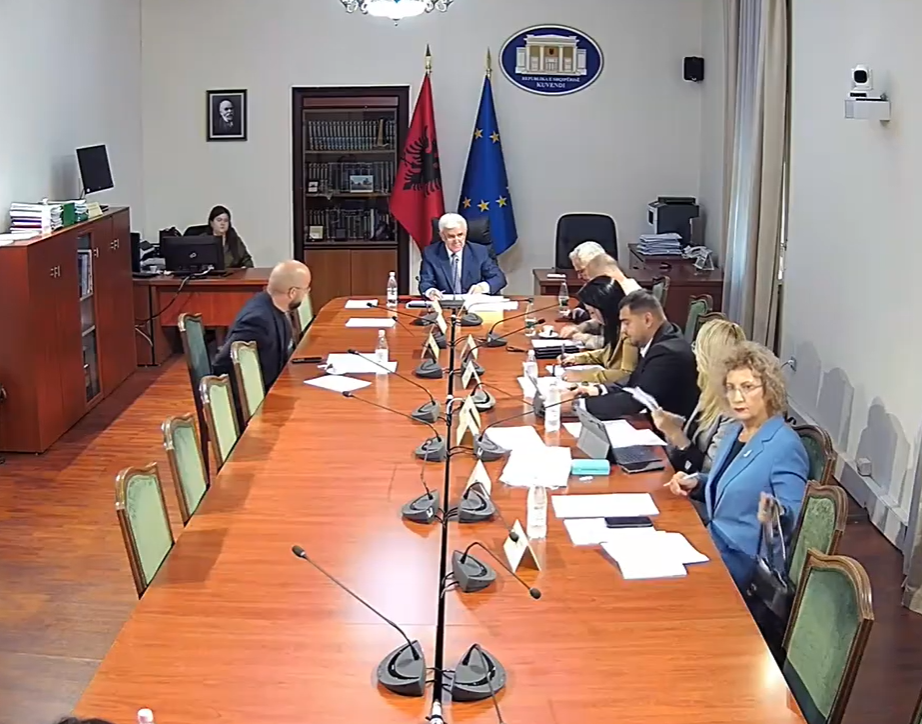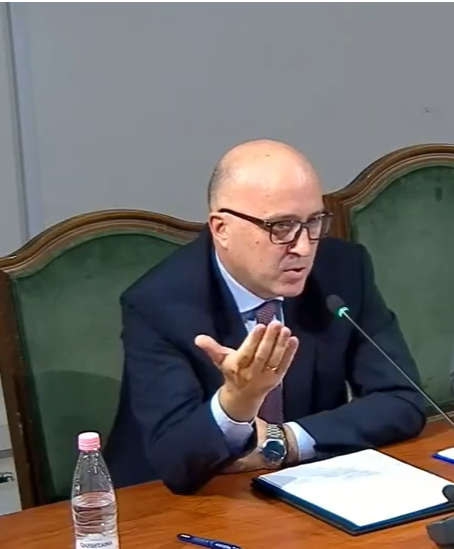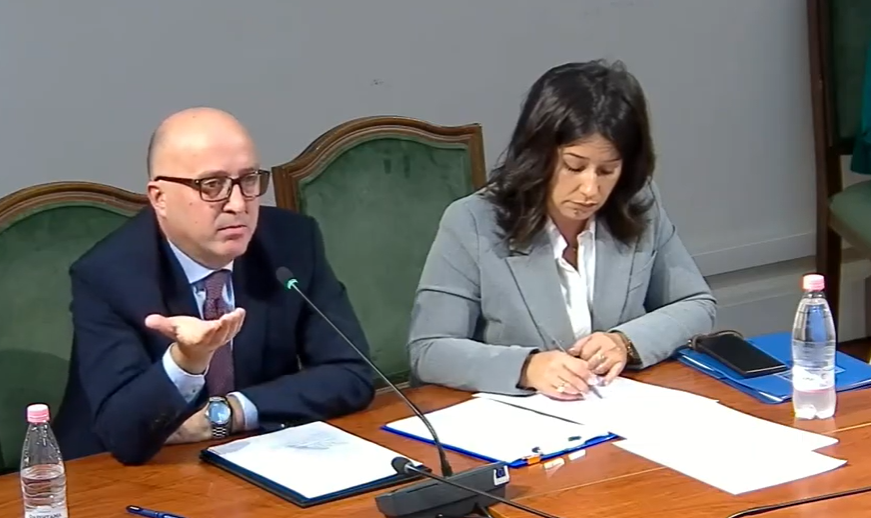
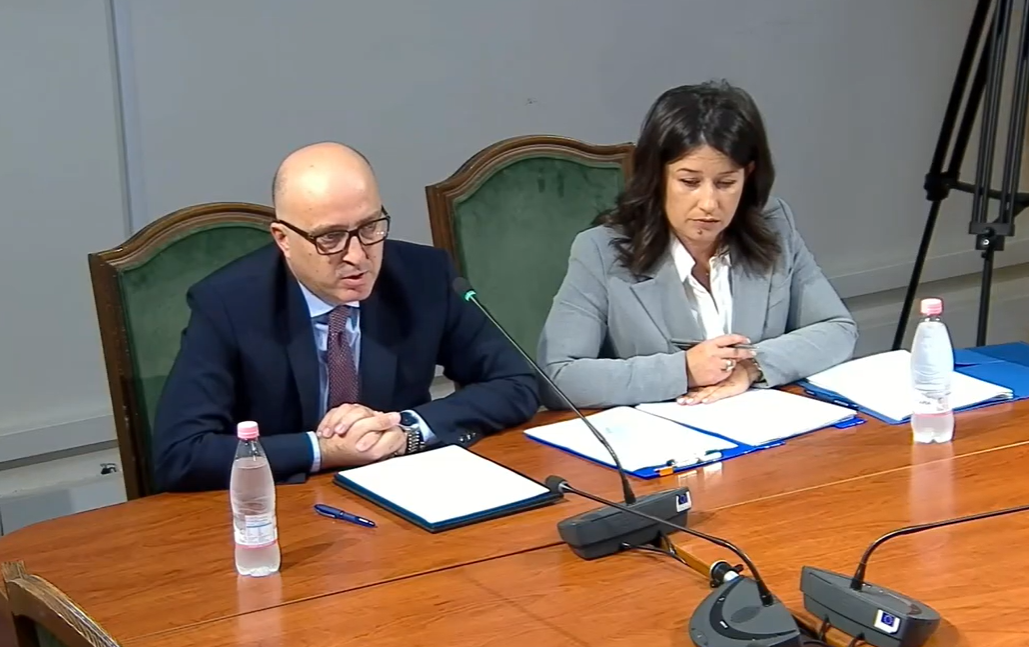
Chairman of the Commission Mr. Fatmir Xhafaj: The first session is with the High Justice Inspector. Present to represent the Inspectorate is Mr. Artur Metani, High Justice Inspector, and Ms. Eljona Bylykbashi, Director of Legal Services. Welcome. Thank you for your understanding regarding the change in the schedule, because it was necessary for us. I appreciate your understanding. You are aware of the issue that is the subject of this hearing session. We have also received a document containing information from you in response to the request submitted by the Commission. I would initially ask for a very brief, concise presentation. As a rule, we spend 5–6 minutes on this type of session, in the sense that, in order not to repeat what you have presented in the information provided, since it is already known to the rapporteurs and members of the Commission and the advisers, but rather to emphasize two or three necessary points that you consider should be the focus of the attention of the members of the Commission and that are of public interest. Then we will hear the rapporteurs and afterwards the relevant questions. First, the floor is yours, Mr. Metani.
High Justice Inspector Mr. Artur Metani: Thank you, Chairman. Good morning once again to all the members. As you said, I would like to focus very briefly on only two or three things, since the material is already before you. In implementation of the legislation, which delegates decision-making powers to the High Justice Inspector to issue secondary legislation, all obligations have been fulfilled; they have been fulfilled within the legal deadline. Therefore, today there is no act or any obligation to issue a secondary legislative act on the part of the High Justice Inspector that is delegated or authorized by law. In relation to the cross-sectoral justice strategy, the High Justice Inspector has no secondary legislative act to issue. In relation to the integration process, in implementation of its main documents, the Progress Report or also the Report on the Rule of Law and the Rule of Law, the High Justice Inspector has not had any specific obligation to issue any legal act. In general, the reports of the European Union have assessed the activity of the HJI positively, even using terms indicating that the accountability mechanism functions satisfactorily, but they have focused on two or three elements that I would like to mention. The first is filling the vacancies for inspectors at the Office of the High Justice Inspector, and this is a permanent recommendation. Therefore, in every Progress Report, this remains the first recommendation. The second recommendation has been increasing the number of thematic inspections, which the High Justice Inspector has fulfilled, and it is no longer a recommendation, at least for this year. The third recommendation is also the further implementation or transmission of vetting standards into the activities of the bodies of the High Justice Inspector in this case. Regarding this obligation as well, the High Justice Inspector, in cooperation with EU4Justice and the vetting bodies themselves, has drafted a specific methodology, which must be followed when exercising the powers of the High Justice Inspector in two cases: in the case of recruitment or appointment of non-magistrate inspectors, as well as in the case of investigations of a financial nature when magistrates are under investigation. This material has been consulted on, and training has also been conducted with the inspectors of the Office of the High Justice Inspector, with experts from the International Monitoring Operation (IMO). This material has been presented at the general meeting of inspectors and has been provided to the inspectors for guidance, so that they keep it in mind for implementation when they are part of teams or investigations in the two cases I mentioned above. Thus, in this sense, the obligation of the High Justice Inspector to issue secondary legislative acts has been fulfilled from the perspective of the High Justice Inspector. Thank you.
Chairman of the Commission Mr. Fatmir Xhafaj: Thank you. Now let us hear the assessment of the rapporteurs. The rapporteurs in today’s hearing sessions are Ms. Romina Kuko and Mr. Erion Mile. Yes, Ms. Kuko?
MP Romina Kuko: Thank you, Chairman. Dear colleagues, Honorable High Justice Inspector. One in three citizens turn to the High Justice Inspector, and they do not complain only about the content of the decision they have received in their hands, but because the case is not coming to an end. They wait for months, for years, for a trial or for a reasoned decision that is not delivered to them. The law considers this a possible violation by the judge or the prosecutor and charges the Inspector with verifying it. Both in the spirit of this Commission and in the scope of this Commission, this citizen is at the center of our report today.
I must emphasize at the outset that this review fully respects the independence of the judiciary and of the Inspector; therefore, it does not touch upon any specific case, but only the way the system functions. On 6 May 2026, within the framework of post-legislative scrutiny of secondary legislation and the implementation of laws for the period 2021–2026, the Commission requested information from the Inspector regarding his obligations. The Inspector responded on 21 May: there are no new laws imposing obligations on him, there are no unapproved secondary legislative acts, and there are no obligations regarding alignment with the acquis. As regards the current situation, of course, this stands as the report; however, two key acts with statutory deadlines were adopted late: the system for evaluating inspectors, by approximately 13 months, and the regulation of the complaints management system, by approximately 26 months. These are certainly delays, and their consequences are still being felt today, but post-legislative scrutiny does not ask only whether the acts exist. The fundamental question is whether the law, together with these acts, achieves its purpose.
For the Inspector, this purpose is achieved through two functions: the verification of complaints and inspections. Our assessment proceeds from this point. During 2025, 74% of complaints were archived at the initial review stage, 23% after verification, and only 3% proceeded to investigation. The Inspector explains the archiving by the fact that most complaints challenge the substance of the decision, which falls outside his competence. And, of course, this is correct, but the same group also appears to include complaints about delays, which account for around one-third of all complaints, as well as those concerning delays in providing reasoning. These fall within the Inspector’s competence. And our question is: does the complaints management system register complaints about delays as a separate category, and how many of them were archived without verification?
The Inspector explains the delays by the workload of the system. This argument applies to the system as a whole, but it does not apply to a judge who takes much longer than his colleagues under the same conditions. Now, there is also an official point of reference: standard time limits that the High Judicial Council approved in July 2025. Therefore, we want to know whether the Inspector is taking those time limits into consideration in his inspection activities during 2026.
In implementation of the Assembly’s resolution, at the end of last year the Inspector approved an order for periodic reports on complaints, intended to show what citizens complain about most, and of course, this is positive; however, 10 months later, according to the information provided to us by the Commission’s advisers, the order has not been published and no report has yet been drafted. And without these reports, it is not possible to see how citizens’ complaints are translated into inspections.
The law gives the Inspector the right to inspect every aspect of the work of judges and of the courts and prosecution offices. The question arises: what is the effectiveness of the implementation of the law, which is the main focus of our parliamentary post-legislative scrutiny in this hearing. And I see this in two or three important aspects, with the assessment also supported by the findings of European Union reports and the concerns continuously raised by citizens themselves.
First, let me pose the specific question of whether the annual plan addresses the biggest problems facing the justice system. Of the 9 inspections planned for 2026, none addresses three issues that the European Union and the adopted strategies have placed at the top of the agenda. The first is the backlog and duration of trials at the Court of Appeal, where, at the beginning of 2025, there were around 41,700 pending cases. The second concerns the administrative courts, with pending cases dating back to 2017–2018. The third is corruption in the judiciary, for which the European Commission’s 2025 Progress Report calls for inspection protocols, and the report assessing the interim benchmarks describes it as a “substantial concern.” None of these was included in the 2025 plan.
Furthermore, the selection criteria are still not published. The Inspector regularly receives data from all courts and prosecution offices, but the thematic areas are based mainly on proposals from other institutions. In his report, the Inspector notes difficulties in understanding the reasons behind some proposals. The same problem appears in the annual inspection of case allocation by lot, which the law makes mandatory. Three courts are selected each year without published criteria. Courts with greater caseloads, such as those in Tirana, the administrative courts, or the Special Court, have not been included, even though the 2025 inspection found that manual allocations by lot and reassignments are not tracked in the system.
Even when inspections concerning the duration of proceedings are carried out, the result is limited. They cover only cases closed within a three-month period, meaning that the older backlog remains outside their scope, precisely the backlog about which citizens complain. Reports are issued 20 to 24 months after the period inspected. Of the 9 inspections in the 2025 plan, only 4 were completed within the year. In some inspections, significant differences in the duration of proceedings between judges were found, but no individual verification was recommended, and the findings were not referred either for disciplinary investigation or to the evaluation file. The law envisaged inspections precisely as a source for these two processes.
And I would also like to mention a positive example: the inspection of court hearings in 2025 covered 10 months, analyzed scheduling for each judge, and was reported within 4 months. This shows that it can be done. And we want to see this approach extended to the duration of proceedings as well.
Meanwhile, staffing remains another issue that requires an answer. The Inspector works with half the number of inspectors he needs, that is, with 10 vacant positions out of the 20 positions provided for in the structure. The Assembly recognized this problem and, in January of this year, amended the law to make these positions more attractive: it reduced the required seniority, increased salaries, and regulated secondment. The lack of candidates is certainly not dependent on the Inspector, but the speed of the procedures is. And the request for judge-inspectors was made two months after the amendment to the law, while the procedure for non-magistrate inspectors began five months after it.
he previous procedure lasted 19 months and ended without a successful candidate. The effects of the old delays are also felt here. The system for evaluating Inspectors, which was approved one year late, meant that by the end of 2025 only 4 inspectors had been evaluated. The Deputy Inspector was appointed only in April of this year, more than 6 years after the institution was established, and the terms of the 4 prosecutors seconded in 2021 expire this year.
Therefore, on this basis, Honorable Chairman, I propose that the Commission recommend to the Inspector the following: first, to register complaints concerning delays as a separate category and report to this Commission how many of them were archived without verification in 2025; to draft and publish the first periodic report on complaints by a specified date; to include in the 2027 inspection plan the duration of trials in the priority courts as defined by the strategy, the administrative courts, and judicial corruption; to publish the selection criteria together with the plan, both for thematic inspections and for inspections of case allocation by lot; to extend the approach used in the inspection of court hearings to the duration of proceedings as well, with an analysis for each judge and the follow-up of findings through evaluation, including, where appropriate, referral for disciplinary verification; to submit to the Commission, within 30 days, a timetable for filling the vacant inspector positions and for evaluating inspectors by the end of 2027; and to send the 2027 inspection plan to the Commission as soon as it is approved.
Now, the Assembly amended the law and did its part, and therefore we all want to see the changes translated into action, so that inspectors get to work, go where the problems are, and we have a genuine response for the citizen. Thank you.
Chairman of the Commission, Mr. Fatmir Xhafaj: Thank you. Thank you, colleague Kuko. Yes, Mr. Inspector, please.
High Justice Inspector, Mr. Artur Metani: Thank you, Chairman. I listened very carefully to the rapporteur’s statement. I must say that many of the findings do not hold up. We will prepare a written document on this and submit it to the Commission within a few days. But, simply to point out that the legal amendments concerned magistrate Inspectors, not non-magistrate Inspectors. Therefore, they are not related to the delays you mentioned.
Secondly, since you mentioned the act on the evaluation of Inspectors, the act on the evaluation of Inspectors was issued in 2021, and in 2020 the High Justice Inspector did not even have a desk to sit at. Nevertheless, within that year, the Inspector carried out a thematic inspection, conducted disciplinary investigations, handled complaints, carried out recruitment procedures for inspectors, and more, and without a doubt, all of these were undertaken in turn. And all the other elements that the rapporteur mentioned as well.
Nevertheless, as I said, we will submit a written document to you to perhaps provide you with a better understanding of the matters and issues that were raised. The reasons for the selection and the manner in which Inspectors are selected, the thematic areas, and the thematic inspections have been made public, because perhaps I have said this here before, or I have said it at the Law Commission; I always say it publicly, and I have always said it in my interviews: the way thematic inspections are selected and the choice of thematic inspections are absolutely not an individual choice of the Inspector. The matter goes through the General Meeting of Inspectors, after the opinions of the institutions have been obtained, even though the law does not require this, after the problems of each court and each prosecution office have been considered, and after an analysis has been carried out of the phenomena giving rise to complaints from the previous year, balancing all of this against the small number of inspectors, which is not the fault of the High Justice Inspector, or because of delays, since the delays do not originate from the High Justice Inspector; they arise from other institutions whose responses are delayed, whether rightly or wrongly, that is something we can examine.
However, those who compete and apply to become Inspectors, that is, if one is to become a High Justice Inspector, go through a framework or a rigorous process, what I would call a “vetting” process, just like the High Justice Inspector himself or members of the Constitutional Court when they go through the High Judicial Appointments Council (KED). Thus, it is a very lengthy process.
Nevertheless, as I said, we will send the document within a few days, including all the responses or views of the High Justice Inspector regarding these findings. Thank you. Nevertheless, we will consider the suggestions.
Chairman of the Commission, Mr. Fatmir Xhafaj: Thank you. Although, to be honest, you are entitled to your objections. It is a very good thing that you will submit your comments and assessments regarding the rapporteurs’ findings and suggestions in writing as well. But, as you yourself said, there are also points that are valid, and I would have wished, as I believe is appropriate, that just as you challenge findings that do not align with your perspective, your position, and the information available to you, you should also have acknowledged those that are valid, because it is in our common interest, and no one, no institution, can identify the problem unless it also acknowledges what the shortcomings are, what the mistakes are, and what needs to be reflected upon.
Because I believe we share the same view on the fact that the High Justice Inspector is a key institution in the system. In my assessment, the High Justice Inspector is the barometer of the problems and concerns affecting the system as a whole, and the effectiveness of the work of the entire system depends greatly on how the Inspectorate functions and on its efficiency. And if there are expectations for more and better results, this undoubtedly stems from the law and from your responsibilities, but I believe it is also our legitimate concern as legislators and representatives of citizens’ interests at this table. In any case, okay, we can continue. Who has questions? Yes, Mr. Çomo.
MP Bledi Çomo: Thank you, Chairman. I wanted to ask how the recommendations of the European Commission’s Progress Reports have been reflected in the secondary legislation, methodology, and inspection plan of the HJI, particularly regarding judicial delays and the risk of corruption in the judiciary, and which measures remain to be implemented and within what deadlines.
First, and since you also touched upon thematic inspections, I wanted to raise a question. Has there ever been an inspection topic aimed at verifying how the amnesty is implemented and how its effects are extended so that citizens are not adversely affected by the granting of the amnesty and can benefit from it, since the law grants them this right?
This question arises from cases in which the prosecution changes the legal classification of the offence when the amnesty is issued, thereby worsening the position of the person concerned, while, on the other hand, the court delays the examination of the case, with the aim of preventing the individual citizen from benefiting from the amnesty. So, have you had such an inspection topic, and have you ever verified how these provisions are being implemented? Thank you.
Chairman of the Commission, Mr. Fatmir Xhafaj: Yes, thank you.
High Justice Inspector Mr. Artur Metani: Regarding the second question, yes. Amnesty has been a matter of inspection and verification. The amnesty, not the most recent one but the one before it, was also verified and resulted in specific recommendations, and because of those recommendations, in the implementation of the latest amnesty there have been no issues of the kind identified by the High Justice Inspector during the inspection carried out.
Regarding the EU recommendations on the issue of judicial corruption, yes, they have been reflected in thematic inspections concerning the drawing of lots in courts, the allocation of cases in prosecution offices, and the replacement of prosecutors, as issues or topics that may create the conditions for bias or for the creation of unfair advantages for the parties. These are inspections that are carried out every year, and the recommendations we make are, without a doubt, also sent to the High Prosecutorial Council, the Prosecution Offices, and the High Judicial Council, as appropriate.
Regarding delays, these too are matters of thematic inspection every year. Delays, that is, the duration of the reasoning of decisions and the preparation of written judgments, as well as the duration of judicial proceedings, are recommendations made every year. Depending on the available resources, inspections are carried out in almost every court. So, one year we inspect two or three courts, another year we inspect two or three other courts, and so on, trying to cover the entire territory. That is all I have. Thank you.
Chairman of the Commission Mr. Fatmir Xhafaj: Thank you. Who has another question? Yes, Ms. Dhima.
MP Antoneta Dhima: Thank you, Mr. Chairman.
Chairman of the Commission Mr. Fatmir Xhafaj: Please keep the discussion focused on the subject from the perspective of the law, because the Inspector may come again, and will come again, so when the relevant topic is on the agenda. Excuse me, my apologies.
MP Antoneta Dhima: Thank you, Mr. Chairman. Following your discussion and comments regarding effectiveness, I want to focus mainly on the effectiveness of disciplinary procedures. How many cases have been referred for disciplinary proceedings to the High Judicial Council and the High Prosecutorial Council, and what were their final outcomes? This concerns the period 2021–2025. Have any delays or obstacles been identified in the implementation of the procedures provided for by law?
And secondly, regarding shortcomings in the implementation of the legislation, what legal or institutional problems have been identified during the exercise of the powers of the High Justice Inspectorate for the period 2021–2025, and what legal amendments or other amendments to secondary legislation have been proposed to increase the effectiveness of investigations as well as disciplinary accountability? Thank you.
Chairman of the Commission Mr. Fatmir Xhafaj: Yes, thank you. Mr. Inspector…
High Justice Inspector Mr. Artur Metani: Now, as you said, Chairman, the first question relates to the activities of the institutions, although not to today’s topic. Nevertheless, I will answer you to the extent that I can recall over five years. What I clearly remember over five years is that, in no case involving disciplinary proceedings requested by the High Justice Inspector, have the Councils decided to return the case to the High Justice Inspector for incomplete investigations, investigations that did not meet standards, or investigations that did not justify the measure requested by the High Justice Inspector. In all cases, the Councils have decided that the findings of the High Justice Inspector stand, but, due to their discretion, they have decided differently from the measure proposed by the High Justice Inspector.
As for the figures, without a doubt, every annual report submitted by the High Justice Inspector presents the figures. If you want them in summarized form, this can certainly also be part of the material we will submit later. But that is my answer to the first question.
Regarding the second question, it is, in fact, an interesting one. Nevertheless, I believe that, given the difficulties the system is facing today, it is difficult for us to be in a position to propose legal amendments on the grounds that an aspect of the approved legislation or a mechanism provided for in the legislation has not functioned. This is because I believe, and I also believe the contrary argument, that the legislation has not been fully implemented, 100%, due to the difficulties in which the system finds itself. For this reason, it is difficult to conduct a complete analysis of whether something has functioned or has not functioned entirely.
Nevertheless, I have one preliminary point, which could perhaps be part of another discussion, possibly with this Commission or another Commission, and that is the conduct of thematic inspections. Thematic inspections are a concept mentioned in the law only twice, without any provisions regarding either the procedures or the manner or the deadlines within which these thematic inspections must be carried out.
Nevertheless, in my view, thematic inspection is the strongest tool the High Justice Inspector has to play the role Mr. Xhafaj described, to be a key institution in the system, to detect problems and phenomena that should concern the judicial system or the justice system, and to issue the relevant recommendations to institutions that must take measures. And this can be achieved only through the conduct of thematic inspections.
Therefore, the first amendment that might be needed would be to define more clearly the procedures and the manner in which these thematic inspections should be carried out, which the Inspector has, in fact, established and clarified through his own decisions. I am speaking about legal amendments.
Secondly, there is the question of the authority these recommendations should have. Over these six or seven years of experience of the High Justice Inspector, there have been no problems with institutions regarding the implementation of the HJI’s recommendations. Nevertheless, this has been part of a discussion with the Prosecutor General about whether the recommendations issued by the High Justice Inspector are binding or not. The Prosecutor General’s position is that, as long as the law does not provide that these recommendations are binding, the institution is not obliged to implement them.
Therefore, I believe this should also be part of a discussion at a meeting, when you consider how we should proceed, along with other elements of this kind. Thank you.
Chairman of the Commission, Mr. Fatmir Xhafaj: Yes, thank you. Are there any other questions? All right. I have a couple of questions myself. You rightly mentioned the recommendations or measures that you have to fulfill within the framework of the obligations arising from the negotiation process or from European Union documents. This question is also relevant in relation to the three things you mentioned: vacancies, the increase in thematic inspections, which runs counter to what you said, and the implementation of vetting standards within the system. Among these three, I would like to hear more about the third issue. To what extent are these standards, which were established during the vetting process, being absorbed by the system? To what extent are the two Councils and the Inspector himself responding to these standards, and what can the Assembly, and specifically this Commission, take into consideration, through its function of exercising parliamentary oversight, in order to support this important process?
The second question relates to the fact that it is very good that we refer to the recommendations and findings and recommendations of European Union reports, but, on the other hand, you have a kind of assessment of citizens’ opinions, more so than any other institution in the system. I absolutely believe that we agree on this, because citizens’ concerns are more clearly formulated or more accurately addressed to your institution through the complaints system. From this perspective, I would like to hear to what extent this has been reflected in your internal acts, to what extent it has been reflected in your inspections, and whether you have a measure for assessing how citizens themselves evaluate the Inspector’s work.
In other words, as the head of this very important institution, do you have an indicator by which you measure citizens’ satisfaction and trust in relation to your institution? Naturally, I am not asking you to conduct surveys, because that is not the solution, but I believe you should have one, and there are many internationally recognized instruments that institutions use to understand and assess the level of citizens’ trust and satisfaction with their activities. Do you have such an instrument? Do you use it? And can we also understand how this mechanism works and what the result is?
And following on from this, what interests me most is what place the issue that is perhaps currently the Achilles’ heel of the system occupies in your attention. I believe you had this very much in mind, perhaps as the main factor, when you said that the system is experiencing difficulties. Specifically, the issue of the backlog. Undoubtedly, vacancies are one reason for the backlog, but I have personally said before, here and in your previous reports, as well as in the other Commission, the Law Commission, in previous years, that I do not believe the backlog is the main reason for the vacancies we have in the system. It is an important reason. For a certain period, it was undoubtedly the key reason, just as the pandemic and a number of other factors can also be cited, but today, today, from my perspective, it is not the main reason.
Today, the main reason is the way the system approaches matters, the accountability of judges and prosecutors, and, in particular, that of the institutions and the governing structures of the system, including the functioning of the two Councils. And this brings me to the next issue. From your perspective today, insofar as you also serve as an indicator of the state of the system and an assessment of the system’s functioning and efficiency, how are the two Councils performing today, and is there any way in which the Inspector can influence the improvement of this performance?
Today, the two Councils are the two most criticized institutions in the system by public opinion, by the Assembly through its findings and other recommendations and through its resolutions, and by the European Union’s Progress Reports themselves, since you refer to those more readily. We are concerned about this kind of performance, and to a considerable extent we see it as being linked to the effectiveness of the Inspector’s work. I do not know whether I was clear in… Yes, thank you.
High Justice Inspector, Mr. Artur Metani: Yes, Chairman, thank you. Let us take these one by one. Regarding the brief comment you made that increasing thematic inspections is in contradiction with the low number of inspectors, I did not actually understand that clearly, but it is not a contradiction. The obligation or recommendation of the European Union was to increase the number of inspections, and we have treated this as a priority, not only because it comes from an organization we want to join, but also because we see it as a genuine value of modern judicial inspections or inspection services. For this reason, we have prioritized increasing the number of thematic inspections.
Yes, there are delays in completing thematic inspections, as the rapporteur also mentioned, and this brings me to your point that there are things the High Justice Inspector can improve. But, naturally, these are not issues arising from a lack of willingness; rather, they arise from the limited resources available to us, because we must meet not only the increased number of thematic inspections, but also the number of complaints received, the number of disciplinary investigations, the number of disciplinary proceedings, and so on.
Regarding the first question, then, the question about vetting standards. This is a very important question, because we had already been discussing and considering it long before the mandate of the transitional re-evaluation bodies came to an end. We held discussions with these bodies, as well as with representatives of the International Monitoring Operation (IMO), who raised as a recommendation and concern that the standards of these bodies should become part of the work and working procedures of the institutions responsible for the governance of the justice system, particularly the High Justice Inspector, insofar as this concerns the two powers you mentioned earlier.
The question we have always asked both the vetting bodies and the representatives of the IMO has been: what standards do they consider should form part of the work of the High Justice Inspector? In other words, what does the IMO or the vetting bodies consider to be the standards applied in their activities? This was the subject of several months of discussion. In the end, neither of these two institutions presented a document setting out the standards of these bodies; instead, they referred us to and stated that they had established the standards through the decisions they had issued.
We have examined the matter, insofar as it falls within our remit, regarding the two powers that the High Justice Inspector must exercise: recruitment, or the financial investigation of magistrates who are part of a disciplinary investigation.
Yes, without a doubt, this is something that is not related to the core activity of the High Justice Inspector. It is one aspect, one dimension of the High Justice Inspector’s work, because it requires financial and economic expertise, which we are trying to develop or obtain through the training we conduct, as well as through new recruitments, giving priority to candidates with economic backgrounds. I am referring to assistant inspectors, for whom recruitment with this profile is more flexible, because the law provides that Inspectors must, without a doubt and necessarily, be lawyers. Therefore, we are trying to address this shortcoming as well by recruiting people with economic backgrounds for this work process.
Nevertheless, I believe that before we discuss, or before this vetting standard is technically implemented, we must recognize that the vetting standard generally requires high integrity, transparency, and institutional performance, which I believe the High Justice Inspector provides. Before exercising the power, citizens must have trust in the institution, in the integrity and morality of the institution, and this is what we try to uphold every day; we try to implement it every day. And, to come to your second question, we also try to measure it to the extent that we can…
Chairman of the Commission, Mr. Fatmir Xhafaj: Excuse me, I am not questioning, to be completely straightforward with you, the issue of integrity. I am questioning, and have consistently questioned, the issue of effectiveness in relation to what the law requires and what citizens expect, and what we all expect from your office. This is what I have questioned, and I continue to question it. I have never personally questioned, since I was the one who asked the question, the issue of either your integrity or that of the inspectors, because I have no reason to do so, as I have no contrary evidence. But since we have remained on this point following my intervention, that was not what it was about; this is not the place to…
High Justice Inspector, Mr. Artur Metani: It is a continuation of the point, Mr. Xhafaj; it does not mean that I was not focusing on this. Now, I am thinking, I am speaking, it is not that…
Chairman of the Commission, Mr. Fatmir Xhafaj: What I want to tell you concerns the issue you raised, and you rightly raised the need to have a specialized structure or specialized personnel for the investigation component, the financial assessment component, or what I would call the financial investigation. Could there not be, while you work toward achieving this, some kind of agreement with the HIDAACI, which is a specialized structure? Could it carry out part of the work for you through a joint agreement? Perhaps it was a suggestion; that is why I interrupted you.
High Justice Inspector, Mr. Artur Metani: Okay, thank you for clarifying that, perhaps for me as well. Yes, but this is not enough. We have already done this. We have an agreement with HIDAACI. So, we obtain HIDAACI’s expertise whenever we need it. The issue is that, according to the discussions we have also held with representatives of the IMO, the vetting standards require something more, which presents us with a legal problem, not a matter of willingness, and I want to explain to you what that is.
According to the vetting standards, the bodies themselves must engage external experts when carrying out these types of procedures, such as in the case of recruiting non-magistrate Inspectors, or in the case of financial investigations conducted as part of disciplinary investigations. In other words, they do not simply require the opinion of HIDAACI or HIDAACI’s assessment of the case.
This is where a discussion arises, one that concerns a matter of principle. Can I, as a public institution, call into question a report issued by another public institution? And this is an issue that matters to me as an Albanian citizen, with regard to the institutions of my country.
Secondly, if I am to engage external experts, should I have some initial indication? In other words, should I assess that the report submitted by the candidate or by the magistrate gives me grounds for suspicion, suggesting that, look, these things are not true? That the report received from HIDAACI is inaccurate, so that I can then turn to an external expert, or should I engage the external expert automatically, from the outset?
These are the discussions we are having, and we are trying to find the right balance between these considerations and the duties I have. When I say “I,” meaning the institution, this is a legal obligation for the institution, but it also relates to the implementation of the Council of Ministers’ decision that regulates the recruitment of magistrate Inspectors, which does not make the engagement of an external expert mandatory.
Chairman of the Commission, Mr. Fatmir Xhafaj: Then change the decision. Propose that it be amended if that is in the interest of the work. That is why we are here. This is what we expected to hear today.
High Justice Inspector, Mr. Artur Metani: Okay. This is part of a discussion that we are having within the office, and perhaps we will present it. But, to clarify the questions you asked regarding the measurement of citizens’ satisfaction or opinions and their trust, I believe that, first and foremost, the institution’s obligation is to be rigorous in fulfilling its legal duties, and this is what we have done from day one.
We apply the law rigorously, according to our understanding of it, and we try to explain to citizens, as far as we can, the role of the High Justice Inspector. I have done this not only through public information, but also by providing detailed explanations of the complaints citizens submit against magistrates, while also explaining the role of the High Justice Inspector in this process.
And that is why one of the criticisms directed at us is that the High Justice Inspector’s decisions to archive complaints are very lengthy. Yes, they are lengthy for this reason.
The High Justice Inspector has undertaken an extensive public awareness campaign throughout the districts, engaging with schools, local government bodies, and local civil society to explain the role of the High Justice Inspector.
Furthermore, the HJI website has for some time included a survey through which citizens can express their views on the work processes they experience with the High Justice Inspector, and the results of this survey are also made public on the same website. This applies whether the assessments are positive or, necessarily, whether there are criticisms of the work of the High Justice Inspector.
We believe that this is one way, first, to give citizens the opportunity to express their opinions about the work of the High Justice Inspector, including physically at the Office of the High Justice Inspector. Undoubtedly, citizens are free to express their opinions through other public information channels as well, but what is important is that we receive the information or opinion directly from them. We have the opportunity to obtain it, and we do so to the extent that citizens use the survey available on the website.
Regarding the relationship with the Councils, I would like the institution to have as much trust as possible, but I believe that relations between our institutions should arise or be based, first and foremost, on unquestionable trust, as long as there is no reason not to trust one another.
This means that we follow very closely what happens within the Councils and throughout the system, but we also follow very closely those matters that fall within our legal remit. This is not because we do not want to take action to change something, but because we do not want to take action contrary to the law in order to bring about a change.
For example, the law does not provide for the possibility of the High Justice Inspector conducting a thematic inspection within the Councils to examine how a particular phenomenon is occurring. However, through the complaints citizens have submitted against Council members, we have tried to improve the Council’s activities.
For example, I would like to draw your attention to a complaint from 2021 concerning a conflict-of-interest issue involving Council members. Three members of the High Prosecutorial Council were subject to an investigation by the High Justice Inspector. During the investigation, it was observed that the High Prosecutorial Council, since we are discussing acts and regulations, did not have an act regulating conflicts of interest within that Council…
Chairman of the Commission, Mr. Fatmir Xhafaj: It still does not have one to this day.
High Justice Inspector, Mr. Artur Metani: This is another issue that we are paying attention to, for example, because we included it as a recommendation in this investigation. We sent it to the Council and told it that it is the obligation of the High Prosecutorial Council to issue the act regulating conflicts of interest.
The question that now arises, for example, and quite rightly so, is whether the High Justice Inspector can follow up on the implementation of this recommendation. This is certainly something we need to discuss. Therefore, it is not that we have failed to do this because we do not want to. In other words, it is part of a discussion.
Nevertheless, I want to say that this is the way we see things in terms of overseeing, to the extent permitted by law—perhaps that is not the right word—but monitoring the activities of the Councils, to the extent permitted by law.
As for the situations within the Council itself, I personally also hold a different view: the Council itself should be sufficiently strong to refer the problems it faces to the High Justice Inspector, including by submitting a complaint. In other words, the Council itself, or its members, should submit a complaint regarding the problems within the Council, not because the High Justice Inspector necessarily requires a complaint in order to take action, but because I believe that institutions should be sufficiently strong. This new justice system has provided them with the guarantees to be sufficiently strong and to assume the responsibilities and the burden that come with the positions they occupy.
Thirdly, regarding the relationship with the Councils, we do not live on separate islands. I have a very intensive relationship with the Councils. From the beginning of my mandate, I initiated two or three meetings with the Councils to find common ground, and the term I used was that we should speak the same language of values entrusted to us by the reform.
Undoubtedly, opinions differ and decisions differ, but, in my view, the message we must convey to the body of magistrates regarding citizens’ concerns should be the same. I have not always found support, so to speak, and this is not a criticism; that is how they think. I have other views on how the three of us should act together.
Yes, for example, since we are talking about efficiency and delays, one of the ways in which the High Justice Inspector exercises his powers to address delays, both in judicial proceedings and in the drafting of written judgments, is through thematic inspections. And disciplinary proceedings have also resulted from thematic inspections, and these will be part of the material we submit.
That is why I also reacted to the rapporteur’s report, because we must be very careful about this. Not as a criticism, but I want to emphasize that we must be careful because we are making every possible effort to maintain a balance, both with our legal obligations and with citizens’ concerns, as well as with the concerns of the system itself.
You have now mentioned the Court of Appeal twice, both at the previous meeting when I appeared before this Commission and again this time. We have not left the Court of Appeal out because we do not want to address it. Rather, before conducting a thematic inspection into the delays at the Court of Appeal, we thought we should conduct an institutional inspection to see how that court functions, both in terms of infrastructure, the flow of documentation, and the management of all the case files received from other courts. This is because we must first understand the difficulties magistrates are facing and only then hold them disciplinarily accountable. We may be wrong in our view, but this is our perspective.
Chairman of the Commission, Mr. Fatmir Xhafaj: We do not have a different view.
High Justice Inspector, Mr. Artur Metani: Understood.
Chairman of the Commission, Mr. Fatmir Xhafaj: When we speak about the institution as a whole, we agree, but when we speak about judges and specific situations…
High Justice Inspector, Mr. Artur Metani: Let me finish, then. Since you mention specific situations, there is not a single case—not a single case—in which a magistrate who has appeared before the Office of the Inspector, at the desk of the High Justice Inspector, deserved to be dismissed or to receive another disciplinary measure, but no such measure was imposed. There is not a single case!
Intervention off microphone…
Yes, exactly. But now let me finish. This is a concern of mine, and yes, I understand that it is a concern of yours, but it is also a concern of ours. Let us be clear. It is not that we are not troubled by what is happening.
However, we cannot proceed with measures against judges without understanding the problems they are facing. This is not about doing judges a favor, but about genuinely fulfilling the role that the High Justice Inspector must have, maintaining the proper balance between citizens’ rights to see how justice is administered by judges and prosecutors, on the one hand, and their independence and the circumstances in which they operate, on the other.
And the institutional inspection at the Court of Appeal has been initiated precisely to examine what I just described.
The second issue concerns disciplinary proceedings, and I would like you to have followed them. Yes, the High Justice Inspector has referred magistrates for disciplinary measures who delayed the preparation of written judgments by as much as five years, and the Councils rejected those requests.
Yes, but these are precisely the phenomena that have an impact. This is not simply a specific or individual matter.
Nevertheless, the High Justice Inspector has continued, and will continue, to refer magistrates for disciplinary measures whenever he considers that they have been negligent in the performance of their duties, rather than acting as a result of their workload, bearing in mind what you also said.
I believe I have clarified all the questions. If I have forgotten anything, please let me know. Yes.
Chairman of the Commission, Mr. Fatmir Xhafaj: No, I believe there is nothing else that needs to be clarified from the questions I asked, at least. I do not believe the other colleagues have anything else. Both the questions they asked and the presentations made by the rapporteurs were clear. I also agree that, for matters on which you need time to prepare a response, you should take the necessary time to provide a more comprehensive answer, even if we will have another opportunity to meet.
I have one question before making an observation. It is somewhat outside the topic, but it is a current issue, and neither you nor we can stand aside on this matter.
Today, we have a deadlock at the Special Court of First Instance, and there is an open conflict, or, more precisely, an open public disagreement between the lawyers and the Special Anti-Corruption and Organized Crime Court (GJKKO). Is there any possibility of an attempt by the Inspector to intervene to resolve this? Ultimately, the system is the one that suffers, the administration of justice suffers, the service that justice provides suffers, and, in this particular case, the court itself suffers, as do citizens directly.
We are concerned about this. I am convinced that you are also concerned, as part of this system. The question is whether, within the powers granted to you by law, you see a possibility for yourself to intervene and find a solution that is lawful and, of course, fair, so that this deadlock can be overcome.
High Justice Inspector, Mr. Artur Metani: Without a doubt, we are following the situation very closely, and every day we discuss what is happening. To be strictly legal, with the powers that the High Justice Inspector has, we have not, that is, we have not viewed it from this perspective in the first place.
Regarding what is happening, we have considered whether anything might occur that would create problems for the proceedings, because that is important for the proceedings, naturally with consequences for citizens or the participants in the proceedings, and whether the situation might deteriorate or move toward a disciplinary violation.
Secondly, what you mentioned goes beyond the law; it is more a matter for a roundtable discussion between the parties, between the individuals involved in this disagreement. That then goes beyond the powers of the HJI, but it also has to do with human nature and individual personalities, more than with the legal discussions that can take place between the parties.
To be honest, I do not have an opinion on this today, but what I can say is that we are following it very closely, insofar as it falls within our remit. Naturally, as an institution, we would be willing to help to the extent that we can, but this is not something that depends solely on the willingness of the High Justice Inspector.
Chairman of the Commission, Mr. Fatmir Xhafaj: To be honest, I think somewhat differently. Based on my understanding of the law in this regard, I believe there is an angle, a position from which the Inspector could intervene, and it has to do with the cases, because a very important principle is being affected there: the principle of due process of law.
Naturally, there is also, or rather, there is a direct consequence, namely the prolongation of judicial proceedings. From this perspective, the Inspector could intervene to examine whether these acts comply with the standards, whether these acts have been adopted in the proper manner. But the main point is this: I am not questioning the acts themselves, because that is not my duty, and I do not have that objective. My objective—I mean, our objective collectively, all of us together, including you, as you have just expressed the same view—is that we are concerned about the deadlock that has arisen and the effect it produces.
As for what the solution should be, that is for the parties to determine through institutional channels. They are not individuals; they are institutions. The lawyer is an institution in the position he occupies and in the rights and obligations conferred on him by law. The court, the judge, is an institution in terms of the rights and obligations conferred on it by the Constitution and the law.
In this respect, perhaps an intervention would be reasonable. Do you know why? Because I adhere to the principle on which the system itself was built. We speak about the principle of checks and balances and checks between the branches of power, but I believe we understand this in the same way. The system itself, in its architecture, was also built on this internal principle.
People often do not understand this. They do not understand it even when they speak for hours on end or deliver media or public lectures, but the fact is that the system was built in this way. There is no internal hierarchy within the system. It was designed as a system of balances and mutual checks.
And in this respect, the Inspector has an important role in preserving this balance. Here, I would also move on to another issue.
We have become involved in three important matters. The first concerns criminal policy. This is one of the topics on our calendar. The second relates to due process of law. The third concerns cases that are not simply delayed, but backlogged, in the sense that the delay exceeds what would be considered normal, or what is otherwise defined as a backlog.
We deliberately included these matters in our parliamentary oversight calendar, given that they genuinely constitute concerns for public opinion, citizens, state institutions, and the system itself, as you also acknowledged.
In this context, since the High Justice Inspector is an institution that is both the object and subject of this parliamentary oversight, and since, on the other hand, we regard you as a kind of partner in our role as an oversight commission, because both sides have oversight functions, your findings are of great interest to us in relation to all three issues.
We would therefore like you, if possible, to serve personally in this capacity, or perhaps your deputy or someone else in your office, as a kind of point of contact to coordinate these matters with the team, the rapporteurs, and the advisers.
This would allow your findings, given their importance for the conclusions that may be reached through this entire process, to be incorporated naturally as part of the assessments that this Commission will make. The aim is for the assessment to be based on facts and arguments derived from oversight processes—in this case, processes conducted by your office—and not merely on opinions, considerations, or statistical findings, although those are also useful.
In this context, I would invite the Inspector to consider himself, and this is how we see the situation in this case, from this perspective, as a kind of partner to the Commission in pursuit of our common objective. We would like to see more active involvement so that these three issues, which, to varying degrees, are, in our view, very important matters, can contribute to greater public trust in the system and greater effectiveness and efficiency in its functioning.
High Inspector of Justice Mr. Artur Metani: Yes, certainly, Mr. Chairman. In fact, this is also the personal perspective regarding the relationship that this Commission should have, particularly with the justice institutions or with the High Inspector of Justice. First, to share here the concerns that we have, and then the Commission may also exercise its role in overseeing the activity of the justice institutions. Second, just as you said, I would view the relationship between the Commission and the High Inspector of Justice more as a partnership. Indeed, the Commission may also request the High Inspector of Justice to carry out a specific thematic inspection due to its own activity, regarding what you said, and the HJI will try to respond to it as much as it can, with its own assistance, and also through its own inspection, precisely in order to serve that common purpose, so that the Commission may come out with a well-considered opinion on the concerns that the justice system has, the problems, and the way in which we should address these concerns. So, in conclusion, yes, we are undoubtedly ready to assist the Commission and to be a partner in this process, to the extent that we can help you.
Chairman of the Commission Mr. Fatmir Xhafaj: Yes, thank you. Meanwhile, I will also renew an old invitation of yours for the Commission to come to the HJI. It was an invitation from you to come to your premises, to become acquainted with the work, with the system and how it functions, and I would invite my colleagues to respond positively to an old invitation, if I believe that it is still valid.
High Inspector of Justice Mr. Artur Metani: I have repeated it every year.
Chairman of the Commission Mr. Fatmir Xhafaj: Yes, precisely for this reason, I have also renewed it from this position today, so that on a suitable day we can discuss these three topics as well, but also so that the colleagues can become acquainted. I believe that Mr. Kaso also shares the same opinion as me. Yes, because on this point, fortunately, we are not divided into majority and opposition, because these are concerns that concern us; they do not concern the majority or the opposition, but concern the system, which is equally distant from both the majority and the opposition, and we have the same approach regarding what the system should offer to citizens. So, regardless of the various differences, perhaps even very different ones, in many other aspects. Okay, do you have a comment? Okay. Thank you, Mr. Inspector, thank you, colleagues. I believe we agree with the rapporteur’s proposals. The High Inspector of Justice also took them into consideration and likewise requested the necessary time, so that some of them may be addressed during the process, as well as the other issues that we also discussed.
High Inspector of Justice Mr. Artur Metani: Excuse me, on a procedural matter. I mean, I did not agree with the rapporteur’s comments; that is why I said that we would bring material with the findings. With the findings, or, excuse me for the term?
Chairman of the Commission Mr. Fatmir Xhafaj: In our conclusions.
High Inspector of Justice Mr. Artur Metani: So, I think it is more ethical for it to be approved after the comments of the High Inspector of Justice also arrive.
Chairman of the Commission Mr. Fatmir Xhafaj: There is nothing; we do not have anything to approve. We have it here from our perspective; it is the process as we follow it. So, we do not interfere in the Inspector’s decision-making, and the Inspector is also kindly requested not to interfere in our decision-making. But anyway—
High Inspector of Justice Mr. Artur Metani: For the Commission to complain about interference by the Inspector…
Chairman of the Commission Mr. Fatmir Xhafaj: No, I did not say that; I said that he is kindly requested. Okay, I believe we have understood each other. This is important. Thank you, and have a good day. We will continue with the next topic on the agenda.