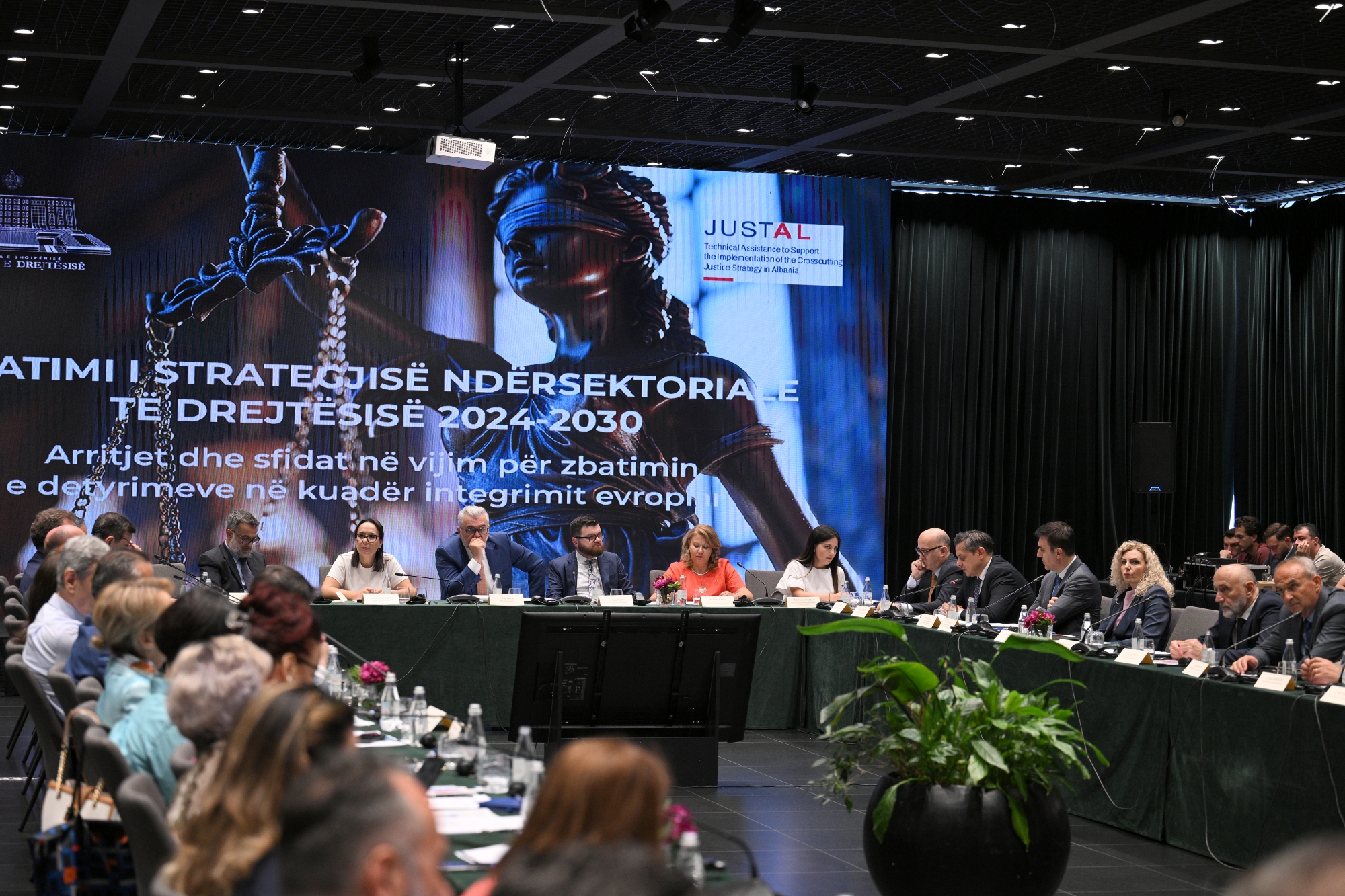
“On the implementation of the Cross-Sector Justice Strategy 2024–2030: Achievements and challenges in fulfilling obligations within the framework of European integration”
Honourable Minister,
Honourable international partners,
Honourable heads of the institutions of the justice system,
Thank you for the invitation, which demonstrates the importance of cooperation between the institutions of the justice system and the other branches of government. This cooperation should be an institutional normality and a permanent way of functioning, rather than a sporadic practice dictated by particular commitments or circumstances.
Today’s meeting represents more than a reporting moment on the implementation of the Cross-Sector Justice Strategy 2024–2030. It is an opportunity to reflect on the way our institutions coordinate their activities, how they measure the results of the reforms, and how they build mechanisms that serve to improve the quality of justice, strengthen the rule of law, and fulfil Albania’s commitments in the European integration process.
Today, the justice reform has entered a new phase. It requires institutions that not only exercise their constitutional and legal powers, but also identify, analyze and address the systemic issues that affect the functioning of the justice system.
According to the annual monitoring report, significant developments were recorded during 2025 across all five pillars of the Cross-Sector Justice Strategy. The second and third policy objectives of the CSJS, which relate to strengthening the independence, impartiality and accountability of the justice system and improving the quality of justice, have achieved significant results despite the challenges identified year after year regarding vacancies. I would mention here the increase in the number of complaints reviewed, as well as the increase in the number of inspections, (thematic inspections) and, consequently, recommendations. Year after year, the High Inspector of Justice has not only demonstrated a steady increase in performance, but also quality through the issuance of recommendations and the measurement of their results, thereby contributing to the improvement of the quality of work in the courts and prosecution offices.
The more than six years of experience of the work of the High Inspector of Justice has shown that the most important challenges are not related only to cases of the individual responsibility of magistrates through disciplinary proceedings, but to the detection of systemic issues that hinder the normal functioning of the justice system, the analysis of those issues, and the provision of a real and concrete contribution to improving the quality of justice and the culture of integrity.
A justice system is not improved only by imposing sanctions.
It is consolidated when it builds the necessary instruments to prevent issues before they produce consequences.
The challenges currently faced by the justice system are neither individual nor the exclusive responsibility of one or several institutions. Many of them are systemic issues, related to the institutional organization, the structure of the system, the heavy workload, vacancies, or the need for legislative intervention.
For this reason, our approach must also evolve. Alongside the analysis of individual responsibilities, we must focus on analyzing the phenomena, identifying the causes that have produced them, and designing sustainable solutions. From a culture based primarily on punishment, we must move towards a culture of prevention, improvement, and the continuous enhancement of the quality of justice. This is precisely what citizens expect from us, and it was one of the fundamental objectives of the justice reform undertaken ten years ago.
The path towards an efficient and sustainable justice system requires institutional coordination, transparency and respect for the principle of the separation of powers. Only through cooperation and shared commitment can we guarantee a justice system that serves the citizen and that can function on the solid foundations of professionalism, integrity and credibility.
No institution can resolve the systemic issues of justice on its own. Competences are exercised individually, but the responsibility for building a functional, effective justice system that responds to the expectations of the public belongs to all of us. If the path towards the conclusion of the negotiations with the European Union, not only as a technical process but also as a process of values, proves successful, then the justice system also has its share of the merit in this journey. But it is equally true that if this process fails, the justice system will also bear its share of the responsibility. Therefore, inter-institutional cooperation should not be seen merely as an obligation to be fulfilled based on the recommendations issued by the Assembly of Albania or on the achievement of the objectives of the Strategy. The coordination of the activities of our institutions should be perceived and developed as an indispensable instrument for consolidating the standards of an independent, efficient and expeditious justice system that responds to the public’s need to obtain justice within a reasonable time.
Today we need institutions that not only respond to problems, but are also capable of anticipating them; institutions that analyze phenomena and recommend solutions; institutions that not only report statistics, but use them to improve decision-making, because the quality of the justice system is determined not only by the decisions it makes, but also by its ability to learn from experience, to correct weaknesses and to build ever higher standards of integrity and accountability.
I am convinced that the new Inter-Institutional Cooperation Mechanism for the Implementation of the Cross-Sector Justice Strategy 2024–2030 and the Justice Scoreboard will contribute to building a new culture of cooperation among the institutions of the justice system, based on coordination, transparency and inter-institutional cooperation. The High Inspector of Justice has offered his full commitment and contribution, because I personally believe that only when we succeed in creating a spirit and culture of sustainable institutional cooperation, without limiting ourselves to identifying quantitative data but by addressing the phenomena that affect us all, will we be able to fulfil the standards required by the European integration process and, more importantly, what the public expects from us and from the reform: justice that is of higher quality, more efficient, more trustworthy and faster.
Thank you!